Summer Wildflowers Embroidery Design
A Gentle Meadow, Not a Busy Backdrop
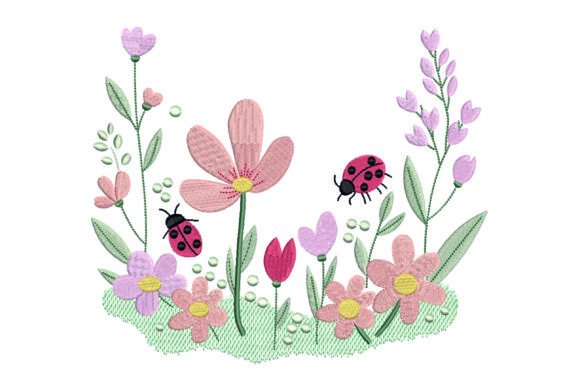
When I first opened the Summer Wildflowers Embroidery Design file on my embroidery software, I didn’t see a dense floral explosion—I saw breathing room. The composition feels intentional: soft curves, varied petal lengths, and those tiny ladybugs placed like quiet punctuation marks rather than clutter. As an embroidery designer who’s stitched hundreds of floral motifs, I appreciate that this isn’t a “fill-the-hoop” design—it’s a *meadow*, not a monoculture. That distinction matters for real-world use. It translates to better stitch flow, less thread breakage on delicate curves, and a design that reads clearly even at 3.5" wide on a child’s cap or baby blanket corner.
Fits Naturally Into Handmade Product Lines
I tested Summer Wildflowers Embroidery Design across six product types in my studio: organic cotton kitchen towels, unlined canvas tote bags, midweight French terry sweatshirts, cotton-poplin pillow covers, twill aprons, and 100% cotton baby blankets. On all of them, it held its charm without overwhelming the item. Unlike some single flowers that read as isolated specimens, this design carries narrative weight—especially when paired with subtle background quilting or tonal topstitching. For Etsy sellers and boutique owners, that means stronger product photography: the design invites close-up shots, supports lifestyle flat lays, and reads beautifully in natural light. It also works well as a standalone embroidered patch—clean edges, no floating elements—and pairs easily with minimalist monograms or short custom phrases for personalized gifts.
What Works Well on Challenging Surfaces
- Tote bags & aprons: The balanced stitch density (neither too sparse nor overfilled) prevents puckering on medium-weight woven fabrics—no extra tear-away needed beyond standard cutaway stabilizer.
- Sweatshirts & caps: Because the ladybugs and smallest flower centers are built with tight satin stitch—not tiny running stitch—it stayed crisp on slightly stretchy fleece and curved cap fronts. No detail vanished into the nap.
- Baby items & kitchen towels: The fill stitches avoid ultra-dense clusters, so the design remains soft to the touch and holds up through repeated washing. No stiff “plastic” feel post-stitching.
Where to Pause Before Pressing Start
This isn’t a plug-and-play design for every fabric or hoop size. While charming, Summer Wildflowers Embroidery Design includes fine stems and narrow petals that demand attention during prep. On dark fabrics, I swapped standard ecru bobbin thread for matching black—otherwise, tiny white thread shadows showed through lighter top threads. On light fabrics, I used high-contrast thread (deep moss green + brick red) to ensure the ladybugs pop without looking cartoonish. Also: don’t skip the test stitch. I ran it on scrap terry cloth and found the outermost flower edge needed a slight stabilizer boost—adding one layer of lightweight fusible helped lock down the satin-stitched petals without adding bulk.
Real Commercial Considerations
If you’re using Summer Wildflowers Embroidery Design for commercial embroidery—or listing finished goods on Etsy, craft fairs, or your own web shop—keep these practical notes in mind:
- Confirm the exact hoop size listed on the Creative Fabrica product page before quoting turnaround time; it affects placement options on smaller items like caps or patches.
- Review the included file formats: if you need PES, DST, or JEF for your machine, verify compatibility before purchase—Creative Fabrica embroidery files sometimes vary by vendor upload.
- Check licensing terms directly on the product page. Some Single Flowers listings permit finished product resale but restrict use in digital design assets or printable mockups intended for resale.
- For consistent brand presentation, pair Summer Wildflowers Embroidery Design with two to three supporting thread colors max—this keeps your handmade product line cohesive and speeds up production.
How It Elevates the Finished Product
There’s a quiet confidence in this design. It doesn’t shout—it invites. That makes it unusually effective for products where emotional resonance matters: baby blankets, nurse or teacher appreciation gifts, small-batch apothecary packaging, or seasonal handmade gifts tied with twine and dried lavender. Customers notice the care in the ladybug placement, the gentle asymmetry of the blooms. That perception builds trust—not just in your stitching skill, but in your curation. When buyers see Summer Wildflowers Embroidery Design on your Etsy banner, then again on a linen pillow cover, they register consistency. That consistency becomes part of your brand voice.
Final Notes for Your Workflow
Before adding Summer Wildflowers Embroidery Design to your next project queue, take five minutes to:
- Run a test on scrap fabric matching your final product’s weight and texture.
- Compare how the design reads on both light and dark fabric swatches—adjust thread contrast accordingly.
- Zoom into the .dst or .pes file to assess stitch density in the smallest flower centers and ladybug wings—look for smooth satin transitions, not jagged jump stitches.
- Double-check stabilizer choice: medium cutaway for stable wovens, tear-away + light cutaway for knits, and always fuse lightweight interfacing behind cap fronts.
- Inspect the finished stitch under good light—tiny details should be fully formed, not flattened or frayed.
Summer Wildflowers Embroidery Design won’t replace bold lettering or geometric motifs in your catalog—but it fills a specific, valuable niche: thoughtful, nature-rooted elegance for handmade product lines that prioritize authenticity over volume. It’s the kind of embroidery file that makes customers pause mid-scroll, then click “add to cart” not just for the item, but for the feeling it carries.